
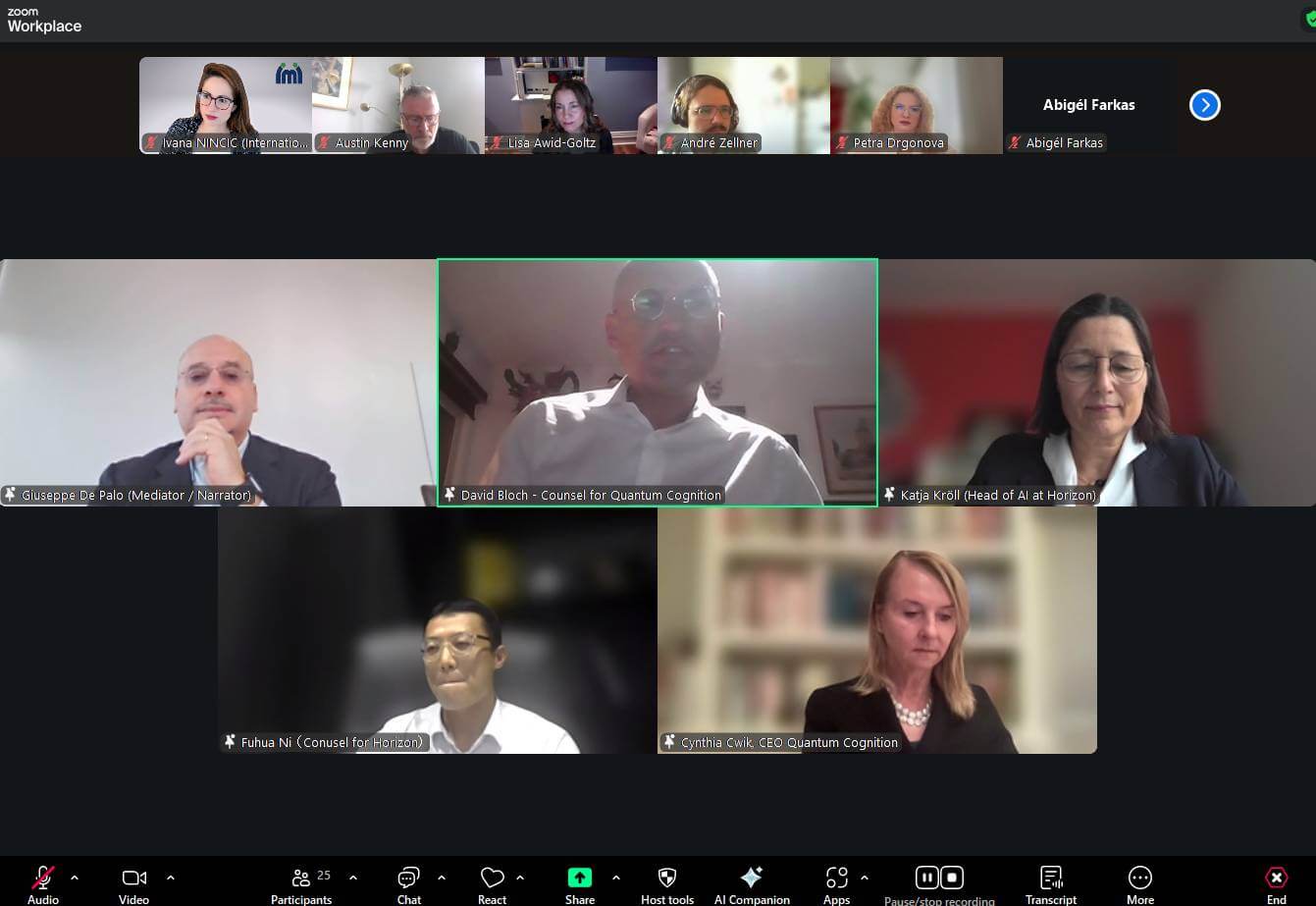

The International Mediation Institute (IMI) kicked off its new fundraising webinar series “Global Mediation Dialogues” with the inaugural session titled “Minds vs Machines” on Wednesday, September 24, 2025. This session featured renowned international mediator Giuseppe De Palo, Esq. (JAMS), who demonstrated the potential usages and limitations of LLMs in Commercial Mediation.
The event was opened with a welcome by Ivana Ninčić Österle, the Executive Director of IMI, welcoming the participants in the event, and outlining the structure and purpose of the event, as well as the broader purpose of the IMIs Global Mediation Dialogues, namely to offer practical insight into ongoing challenges and trends in the field of mediation. This was followed by the introductory remarks of Margaret Poppe, International Practice Manager at JAMS and IMI Board member.
Following this introduction, Giuseppe De Palo, who is a renowned international mediator and arbitrator with nearly three decades of experience, a former Ombudsman for the United Nations Funds and Programmes, the co-founder and Chairman of the ADR Center (Italy) and the founder of the “Dialogue Through Conflict Foundation”, explained the premise of the central case study “Minds vs. Machines”, which he created with David Bloch and was originally launched at JAMS. It sought to explore the potential application of generative Large Language Models (LLMs) for the purpose of solving a real-world International Commercial Mediation dispute, and in particular how an AI Mediator might analyse positions, propose solutions, and handle emotional dynamics, and especially to compare the ability of LLMs to emulate the “human touch” (empathy, cultural understanding and creative thinking) with those of human mediators.

The main part of the event consisted of a Roleplay of the case study with
- Giuseppe De Palo acting as the Mediator
- Cynthia Cwik acting as the CEO of Quantum
- David Bloch acting as counsel for Quantum
- Katja Kröll acting as Head of AI of Horizon
- Fuhua Ni acting as Counsel for Horizon
The case study focused on a simulated dispute between two companies, Horizon (Luxembourg based subsidiary of a Chinese Company) and Quantum (based in Delaware, USA) regarding the purchase of a LLM built, and sold by Quantum to Horizons specifications. The LLM in question is however prone to hallucinations of a potentially illegal nature. Due to this, Horizon refused to pay Quantum for their services, and instead chose to initiate mediation.
The case study tested 5 LLMs, namely, ChatGPT (OpenAI), Claude (Anthropic), Grok (xAI), Gemini (Google) and Perplexity, by presenting them a transcript of the scenario, and asking each of them a series of questions relating to it.
Since the case study was originally conducted, the reasoning and creative abilities of LLMs have significantly improved. For example, the original models interpreted the initial demand of $95 million by Horizon as a realistic figure, and based their analysis on it, while current models recognize it as an anchoring strategy, and scrutinize or disregard the figure.
In conclusion from the study, LLMs do remain inferior to humans, in regards to skills like emotional intelligence, cultural sensitivity and creative option generation, while they excell at tasks like the rapid processing of legal- or technical data. Giuseppe de Palo remarked that as of now, AI is unsuited to replace a human mediator, but could potentially be used to replace tasks such as the processing of large amounts of data.
Across the world organisations are observing this area closely and working towards ethically engaging AI in mediation. For example, the International Bar Association in its new AI Guidelines for Mediation considers AI a potential tool to facilitate and enhance mediation, while subject to safeguards.
Giuseppe De Palo and David Bloch concluded the Roleplay with an analysis of the posed scenario, and analyzed how a Human Mediator could have guided the posed discussion more effectively, followed by a discussion how each of the parties in the scenario could have improved their outcomes.


Donations
IMI is a non-profit foundation, currently funded through mediator listing contributions and donations from mediators/ADR Patrons, as well as the organisation application processing fees and CMTP listing fees. IMI’s revenue is used to cover IMI’s costs, mostly related to the upkeep of the IMI website and organising of events, and to support the further development of mediation standards worldwide.
Support the development of IMI’s major platform upgrade! We invite you to consider making a donation to this essential project, and to help us improve our new online platform by completing the Website Improvement Questionnaire.