


On June 5, 2026, in celebration of World Environment Day 2026, the International Mediation Institute (IMI) hosted an interactive community webinar focused on the critical intersection of Environmental, Social, and Governance (ESG) standards and international conflict resolution. Opened by IMI Executive Director Ivana Ninčić Österle, the session marked an important milestone for the organization. The timely conversation around environment-related disputes was prompted by IMI’s newly formed ESG Mediation Subcommittee, which operates under the IMI Mediation Public Policy Committee. The webinar explored how expanding regulatory frameworks, such as the EU’s Corporate Sustainability Due Diligence Directive (CSDDD), are changing the global corporate landscape, thereby intensifying the demand for highly specialized mediation expertise to handle complex multi-stakeholder and environmental disputes.
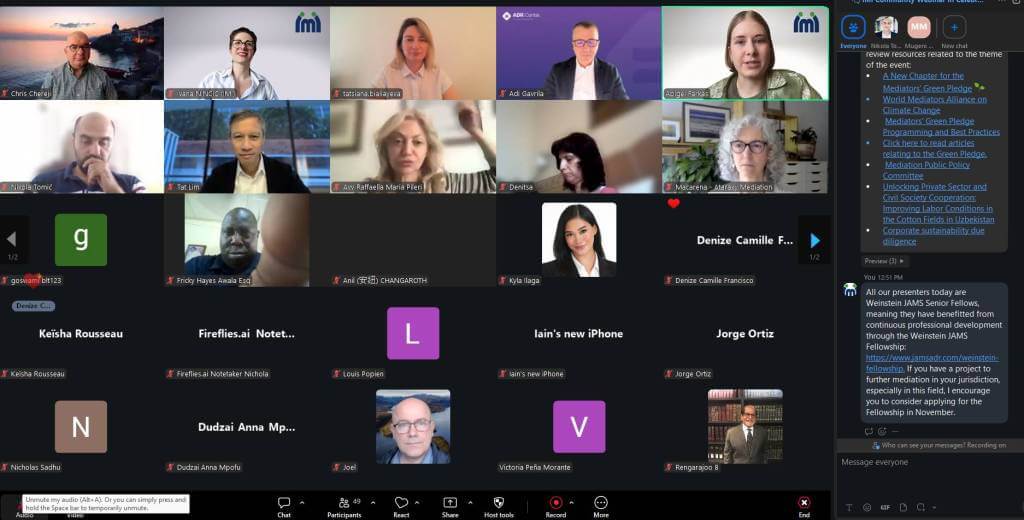
The panel featured three distinguished expert speakers from the front lines of international dispute resolution, independent oversight, and academic research. Constantin Adi Gavrilă, an IMI Certified Mediator and CEO of ADR Center, opened the presentations by examining the role of Independent Accountability Mechanisms (IAMs) in development projects. Tatsiana Bialiayeva, an international mediator and lawyer, followed with a deep dive into practical field mechanics and core mediator competencies drawn from real-world environmental case studies. Dr. Christian Radu Chereji, an IMI Certified Mediator, Professor of Conflict Studies, and Chair of the newly launched IMI ESG Mediation Subcommittee, concluded the main presentations by addressing the broader regulatory horizon and the structural public consultation failures that frequently trigger corporate-community friction.

Independent Accountability Mechanisms (IAMs) and Institutional Grievance Pathways
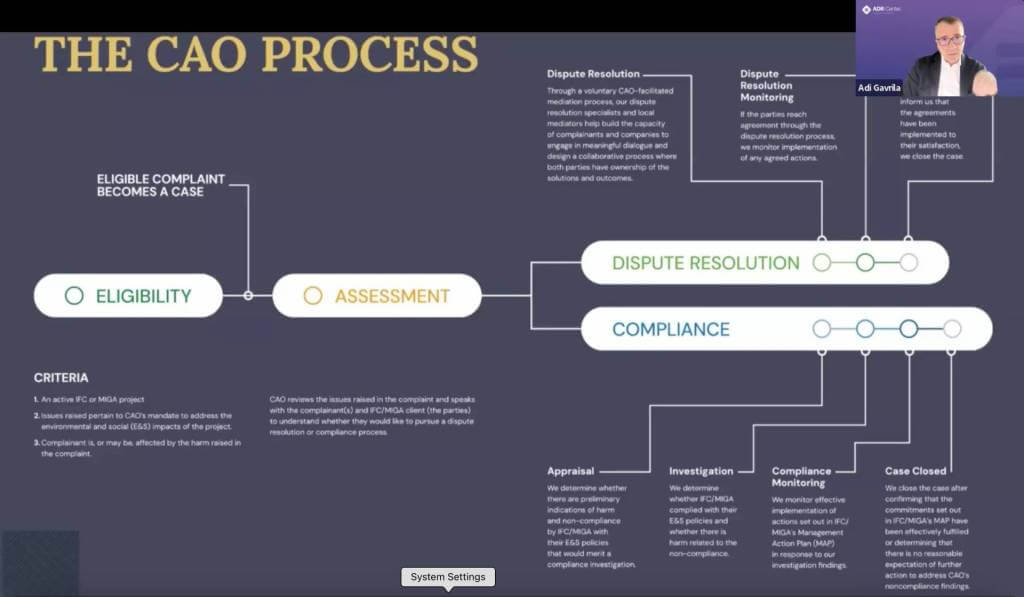
During the first presentation, Constantin Adi Gavrilă used the mechanics of the Compliance Advisor Ombudsman (CAO) to demonstrate how institutional grievance pathways empower communities directly impacted by large-scale infrastructure projects. He emphasized that an ESG mediator’s primary responsibility in these highly unequal settings is facilitating informed choice and capacity-building. This baseline preparation ensures that local stakeholders can engage on equal footing alongside major corporate entities and international financiers, transforming the mediation process into a transparent and balanced space.
Deconstructing Environmental Case Dynamics and Mediator Competency Standards
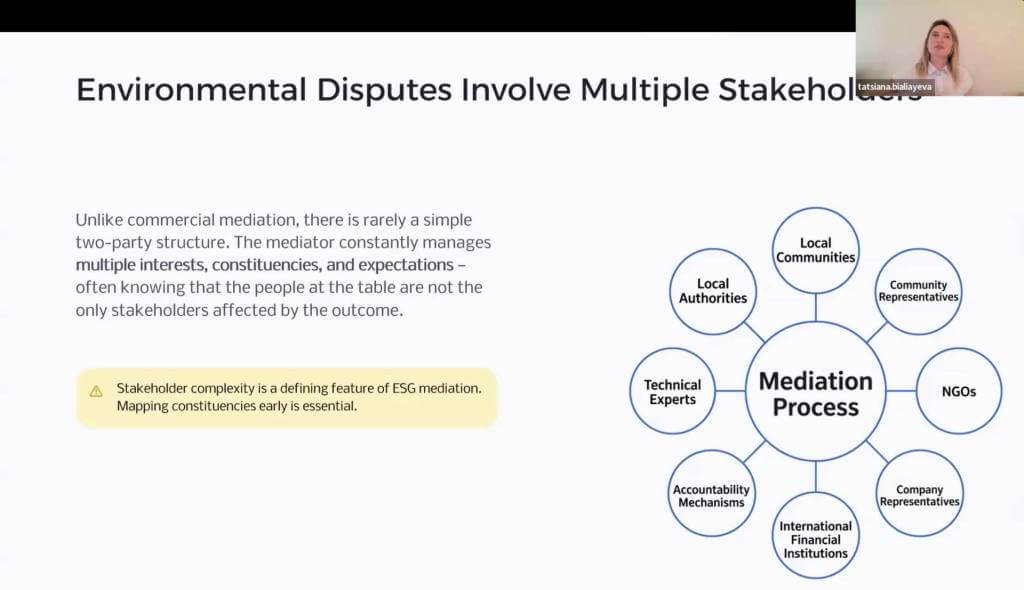
Tatsiana Bialiayeva shifted the focus directly to field dynamics by deconstructing two active agricultural mediation disputes concerning localized environmental harm, including heavy pesticide usage, airborne dust, soil degradation, and water contamination. From these cases, she highlighted the critical mediator competencies necessary for success in complex environmental disputes. These include actively overcoming structural information asymmetry, acquiring technical fluency in environmental baseline assessments without needing full engineering specialization, and managing highly fluid multi-stakeholder complexity. She also stressed the vital importance of resolving scientific disagreements through joint fact-finding, designing enforceable post-agreement monitoring frameworks, and transitioning parties from short-term transactional payouts to permanent, sustainable community-company communication structures.
Navigating the Structural Consultation Crisis and Corporate CSDDD Obligations
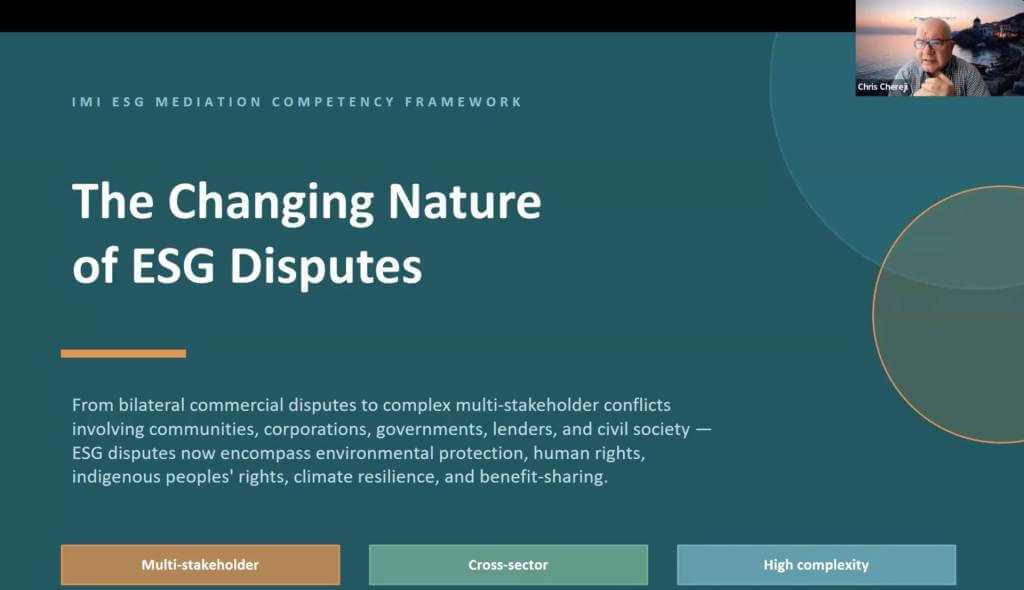
Dr. Christian Radu Chereji connected these field realities to the broader regulatory landscape, noting that statutory frameworks like the CSDDD are turning voluntary corporate buzzwords into strict legal obligations. He shared striking research data proving that over 60% of complaints lodged with institutional IAMs trace directly back to structural public consultation failures. He explained that conflicts rarely stem from technical project parameters alone; rather, disputes spiral because communities feel systemically excluded and disrespected during the early design phases.
This insight matched the open floor reflections, where participants and speakers discussed how communities frequently encounter environmental consultation data retroactively, driving immediate escalation. To illustrate successful intervention, the discussion highlighted a practical infrastructure grievance mechanism in the Western Balkans that successfully resolved over 600 concurrent community disputes on a single project, saving tens of thousands of euros and preventing severe alienation. The collective consensus urged for mediators to be utilized proactively during project design phases rather than merely as retroactive emergency damage control.

Stewardship of the Mediator’s Green Pledge
In tandem with these expert insights, IMI officially announced that it has assumed long-term stewardship of the global Mediator’s Green Pledge, an initiative originally launched by the World Mediators Alliance for Climate Change (WoMACC) to lower the carbon footprint of dispute resolution. IMI’s mandate is to revitalize this global network, modernize its digital infrastructure, and firmly embed sustainable, eco-conscious operations into the everyday fabric of international mediation.
To support this collaborative next phase, all dispute resolution professionals, corporate stakeholders, and legal practitioners are warmly invited to sign the Mediator’s Green Pledge and complete the below Programming and Best Practices Form, helping to crowdsource sustainable operation data and shape future standard-setting initiatives.
Future Outlook & Save the Date
Looking ahead, the webinar marks the beginning of a structured global conversation on ESG mediation competency standards as the ESG Mediation Subcommittee continues its work on a draft competency framework roadmap. The subsequent major milestone in this global initiative will take place as an in-person event in Vienna on July 3, 2026, held in direct support of the CDRC (Consensual Dispute Resolution Negotiation Competition). Further agenda details and registration pathways for this upcoming session will be announced through official IMI channels shortly.
The recording of the webinar is available here.
Passcode: P%T2E5cm