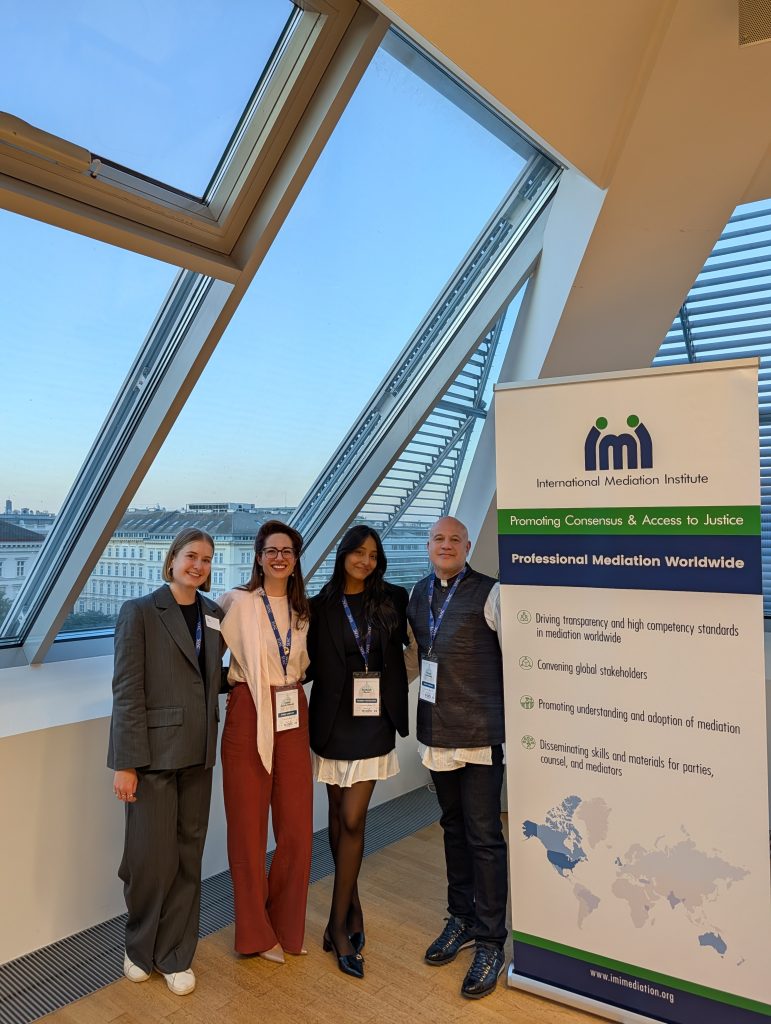
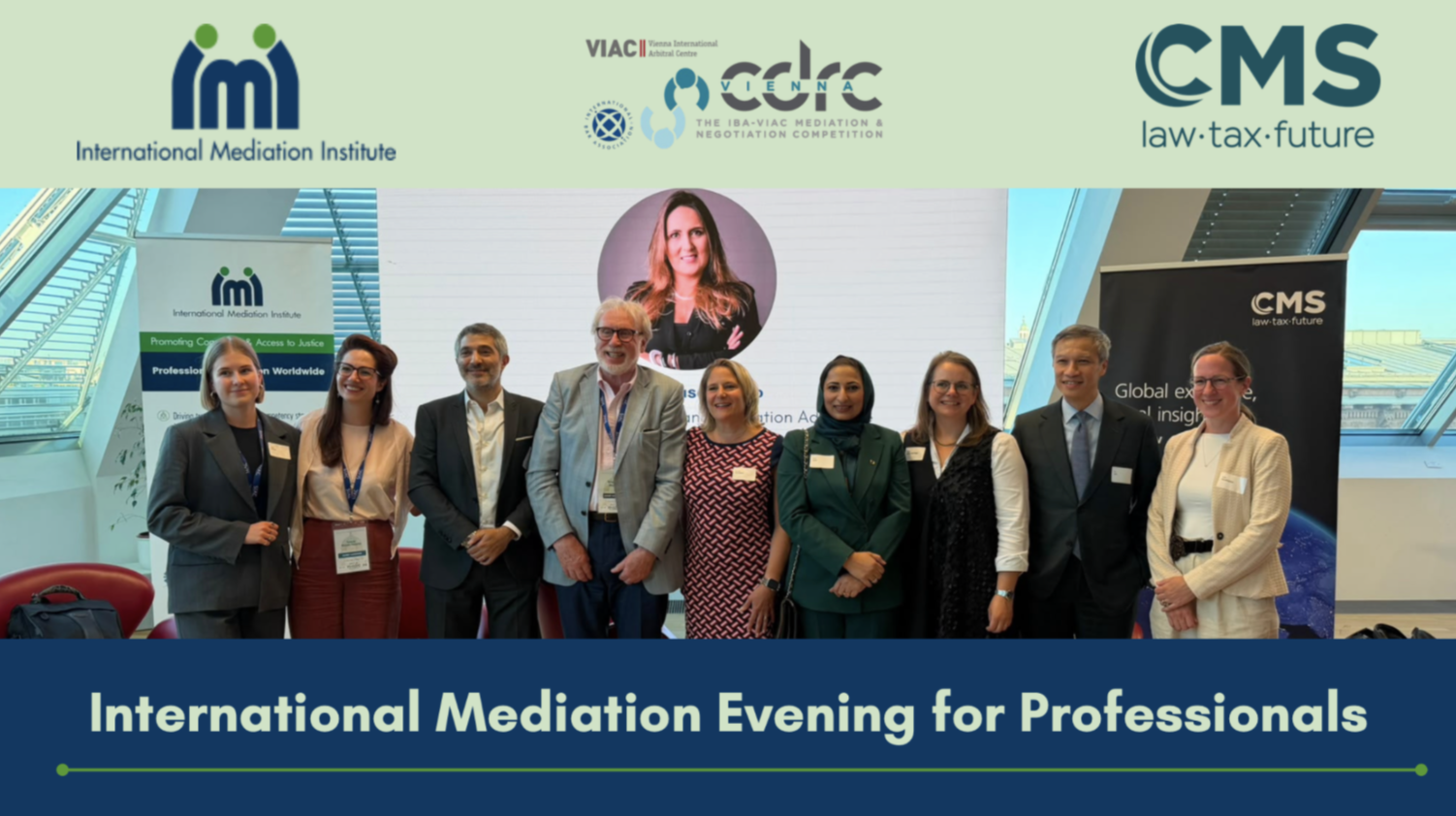

On 3 July 2026, the International Mediation Institute (IMI), in collaboration with CMS Reich-Rohrwig Hainz and the IBA-VIAC CDRC Mediation and Negotiation Competition, welcomed mediators, lawyers, mediation advocates, academics, students, and dispute resolution professionals from around the world for the third edition of the IMI-CMS-CDRC International Mediation Evening in Vienna.
Hosted at the CMS Vienna offices and complemented by an international online audience, the event opened with welcome remarks from Ivana Ninčić Österle, Executive Director of the International Mediation Institute, Daniela Karollus-Bruner, Partner and Head of the Dispute Resolution Practice at CMS Reich-Rohrwig Hainz, Sonja Otenhajmer, Partner and Attorney-at-Law at CMS Reich-Rohrwig Hainz, and Thomas John MCIArb, Director of the IBA-VIAC CDRC. Together, they reflected on the longstanding collaboration between IMI, CMS, and CDRC, highlighting their shared commitment to advancing mediation through international dialogue, professional development, and cross-jurisdictional collaboration.


During her opening remarks, Ivana introduced IMI’s newly launched digital platform, bringing together nearly two decades of certification standards, appraisal processes, and mediator resources into a single integrated system. Currently in its soft launch phase, the platform represents an important milestone for IMI, strengthening accessibility while reinforcing IMI certification as an international trust mark based not only on recognised training, but also on demonstrated mediation experience independently assessed against internationally recognised standards.
We invite you to take time to explore the new platform. This is a soft launch – work on improvements is continuously underway; we would therefore love to hear your thoughts!
If you have feedback, ideas for improvement, or spot anything that needs our attention, please contact us through this form or contact our support hub.
Building on last year’s discussion on mediation advocacy and intercultural competencies, this year’s panel centered on the question: Whose mediation is it anyway? Rather than focusing solely on advocacy skills, the discussion explored how lawyers, mediators, and clients can best work together throughout the mediation process while preserving the collaborative nature of mediation.
The foundation of the panel’s theme were IMI’s Competency Criteria for Mediation Advocates and Advisors, designed in order to establish a professional and technical basis for enabling disputing parties to identify professionals experienced in advising and representing clients in the resolution of disputes through mediation and related dispute resolution processes.
Expertly moderated by Tat Lim, Chair of the IMI Board of Directors and an IMI Certified Mediator and Mediation Advocate, the panel brought together Amelie Huber-Starlinger, Austria-based mediator, mediation advocacy trainer, and Member of the VIAC Mediation Advisory Board, Dr. Beatrice Herrmann, IMI Certified Mediator and negotiation and mediation lecturer at Oxford University’s Saïd Business School, Sarah Tarar, mediation practitioner and Founder of the International Centre for Dispute Resolution Lahore (ICDRL) and CEO of ADR ODR International Pakistan, Stephen Walker, IMI Certified Mediator and one of the United Kingdom’s leading civil and commercial mediators, and Jalal (Jil) El Ahdab, Partner at FIDAL in Paris, Honorary Chair of the IBA Mediation Committee, and internationally recognised practitioner in arbitration, litigation, and mediation.


Advocacy Without Losing the Spirit of Mediation
The discussion began by acknowledging the inherent tension between advocacy and mediation. Lawyers are trained to advance their clients’ legal interests, while mediation depends on dialogue, collaboration, and party self-determination. Rather than viewing these roles as contradictory, the panel explored how effective mediation advocacy requires a shift from adversarial representation towards solution-oriented problem-solving.
Throughout the discussion, speakers emphasised that mediation advocates are not simply litigators operating in a different forum. While robust legal analysis remains fundamental, effective advocacy also requires an understanding of commercial realities, relationships, and the broader interests that shape successful negotiations. As several panelists observed, clients rarely come to mediation seeking a legal victory alone. More often, they seek commercially viable outcomes, preserved relationships, and practical solutions that allow them to move forward.


Empowering Clients Throughout the Process
A recurring message throughout the evening was that lawyers should empower clients rather than overpower them.
The panel explored how responsibilities should be shared between lawyers, clients, and mediators throughout every stage of the mediation process. Rather than prescribing a formula for who should speak and when, participants emphasised the importance of “reading the room” and adapting to the circumstances of each dispute. Effective mediation requires recognising when clients are ready to speak for themselves, when they require additional support, and when mediators should intervene to ensure that the client’s voice remains central to the process.
Pre-mediation conferences, private caucuses, and thoughtful process management were highlighted as valuable tools for preparing parties, clarifying expectations, and creating the conditions for productive dialogue before negotiations formally begin.


Looking Beyond the Legal Merits
Preparation emerged as one of the defining characteristics of effective mediation advocacy.
Beyond evaluating legal claims and litigation risks, panelists discussed the importance of understanding commercial objectives, organisational realities, settlement authority, and the broader interests driving negotiations. Successful preparation, they suggested, extends beyond analysing the strengths and weaknesses of a legal case. It also requires balancing legal expertise with business awareness, enabling lawyers to advise clients not only on legal rights but also on future opportunities, commercial relationships, reputational considerations, and the practical consequences of settlement or continued litigation.

Measuring Success Beyond Settlement
As the discussion turned to the drafting and implementation of settlement agreements, panelists explored the respective responsibilities of mediators, lawyers, and institutions in ensuring both legal and practical enforceability.
While lawyers naturally bear primary responsibility for legal drafting, participants reflected on the continuing contribution mediators can make in ensuring agreements accurately capture the parties’ intentions and minimise the risk of future misunderstandings. The discussion also considered whether mediation institutions should play a greater role in identifying potential enforceability issues while remaining mindful of the professional boundaries that exist across different jurisdictions.
Importantly, the panel challenged the assumption that mediation should be judged solely by whether an enforceable settlement is reached. Successful mediation may equally preserve business relationships, improve communication, narrow disputed issues, or provide parties with greater clarity and confidence in moving forward. The quality of the process itself, participants suggested, is often as valuable as the outcome.


Human Judgment in an Age of Artificial Intelligence
The growing role of artificial intelligence (AI) also featured prominently throughout the discussion.
Panelists recognised AI’s potential to support legal research, litigation risk analysis, document preparation, and scenario planning, allowing lawyers and mediators to prepare more efficiently and make increasingly informed decisions. At the same time, speakers agreed that technology cannot replace the distinctly human dimensions of mediation.
Building trust, exercising judgment, understanding emotion, and facilitating meaningful dialogue remain skills grounded in empathy and experience. AI may strengthen preparation and support decision-making, but the ability to build consensus and navigate complex human relationships continues to distinguish effective mediation professionals.


Key Takeaways for Mediation Advocacy Professionals
To conclude the session, Tat Lim invited each panellist to share one piece of advice for mediation advocacy professionals. Despite their diverse backgrounds and jurisdictions, the speakers converged on a common message: effective mediation advocacy is rooted in client empowerment, thoughtful preparation, and practical judgement.
- “Move from pure legal advice to being a partner to the client.”
- “Trust your client’s voice, be the support, but know that ultimately your client makes the decision.”
- “Be reasonable. Be prepared.”
- “Let your client lead the conversation.”
Together, these reflections reinforced a central theme of the evening: successful mediation advocacy is not about controlling the process, but about equipping clients to make informed decisions while balancing legal expertise with commercial awareness, empathy, and sound professional judgement.
Online Networking Session
The evening concluded with a reception, and, for the online attendees, an international online networking session moderated by Dulce Nascimento, IMI Certified Mediator and Certified Mediation Advocate. Bringing together mediation professionals from Europe, Africa, Asia, and the Americas and reflecting IMI’s commitment to fostering an engaged international community, the online session provided participants with the opportunity to exchange experiences, compare practices, and continue many of the conversations initiated during the panel.
Drawing on the diverse professional backgrounds of the participants, including lawyers, mediators, arbitrators, psychologists, educators, and professionals entering the field from other disciplines, the discussion highlighted how mediation continues to evolve across different legal traditions and cultures. Participants reflected on the practical differences between civil law and common law approaches, including the distinction between mediation and conciliation, differing requirements for legal representation, and the ethical responsibilities of lawyer-mediators operating across jurisdictions. As Dulce Nascimento observed, understanding these jurisdictional nuances is an essential technical pillar for international practice. Reflecting themes explored in her book, The Extinction of Advocacy as You Know It, she noted that today’s mediation advocate is increasingly called upon to move from a “litigation by code” mindset towards a “solution by values” approach.
Building on these themes, participants explored the evolving role of the mediation advocate. The discussion considered how lawyers are increasingly expected not only to provide legal advice but also to act as strategic partners who guide clients through collaborative, interest-based processes. Dulce described this evolving role as that of a “Consensual Architect”, highlighting that effective mediation advocacy requires competencies extending well beyond traditional legal training. She also reflected on how frameworks such as her “Consensual Triangle”, centred on integrative communication, interrelational conflict, and values-based negotiation, can help translate internationally recognised competency standards into practical professional skills.
One particularly thought-provoking discussion explored whether mediators primarily resolve conflicts or work with the people behind them. While perspectives differed, participants broadly agreed that effective mediation requires balancing professional neutrality with a deep understanding of the human relationships that underpin disputes. The discussion also considered the growing role of artificial intelligence in dispute resolution. Echoing observations made during the panel discussion with Tat Lim, participants recognised that while AI can enhance preparation, efficiency, and risk analysis, the uniquely human capacity to build trust, foster understanding, and facilitate lasting consensus remains mediation’s greatest strength.
The networking session also reinforced the importance of continuous professional development and international dialogue. Participants shared common challenges, including managing adversarial behaviours, navigating cross-border disputes, and adapting mediation practice to rapidly evolving legal and technological landscapes. Bringing together more than 30 professionals from across Africa, the Americas, Europe, and Asia, the discussion demonstrated the growing global demand for internationally recognised standards, practical collaboration, and continued learning to strengthen the future of mediation advocacy.

Looking Ahead
The 2026 IMI-CMS-CDRC International Mediation Evening demonstrated that mediation advocacy continues to evolve alongside the changing expectations of clients, businesses, and the legal profession.
Across every stage of the mediation process, from preparation and negotiation to settlement drafting and implementation, the discussion reinforced that effective mediation advocacy requires far more than legal expertise alone. It calls for commercial awareness, ethical judgment, emotional intelligence, cultural sensitivity, and, above all, a commitment to empowering clients to make informed decisions that reflect their own interests and priorities.
By bringing together leading practitioners from diverse jurisdictions, the evening highlighted the value of international dialogue in advancing professional standards and strengthening mediation practice worldwide. Ultimately, the discussion suggested that mediation belongs not to any single professional, but to a collaborative process in which lawyers, mediators, and clients each play distinct yet complementary roles in achieving meaningful and lasting resolution. Through conversations such as these, IMI continues to promote excellence, foster collaboration, and advance the professionalisation of mediation across jurisdictions.
For more information on IMI’s work on Mediation Advocacy please see:
- ISC Mediation Advocacy Task Force
- Interested in becoming a Certified Mediation Advocate/Advisor? Explore Here
- Find a Mediation Advocacy Qualifying Assessment Program here.
Save the Date: Rome, October 2027

Enjoy a few highlights from the evening: