In light of the Week of Integrity 2025, the International Mediation Institute (IMI), in collaboration with ICC Netherlands, organized the webinar “Mediating with Integrity” on 4 November 2025. The event aimed to promote the ethical use of mediation and explore integrity dilemmas. The expert panel featured Omer Shapira, Mary Walker, Lola Akin Ojelabi, and Ellen Waldman.
The event was opened by IMI Executive Director Ivana Ninčić Österle. Referencing the Opening of the Week of Integrity, she emphasized the importance of a culture of integrity, without which no amount of legislation, codes or guidelines will make a significant difference. She highlighted that developing a culture of integrity across borders and mediation practice styles is central to IMI’s mission of driving high competency standards in mediation. Building on the 2020 foundational work of the IMI Ethics Committee, she urged participants to review the IMI Draft Code of Conduct for Mediators and contribute to the second round of public consultations, fostering a collaborative effort to improve its content for the global mediation profession. ICC Director-General and Week of Integrity Foundation Secretary-General Laure Jacquier also commended the event’s importance and its alignment with ICC’s dispute resolution goals.
Participate in the Questionnaire for Public Consultation on IMI’s Revised Draft Code of Conduct.
The Principles of Professional Integrity
In opening the discussion, Ellen Waldman directed the first question to Omer Shapira, asking why integrity is vital in mediation. Dr. Shapira began by noting that integrity is an important yet complex concept with multiple, sometimes overlapping, meanings. He explained that the IMI Ethics Committee reviewed international codes, and was also informed by ethics theories while developing the Draft Code. After several years of work, the Committee concluded that “integrity, specifically professional integrity, deserves its own separate space as an independent principle of ethics” within the Code.
Dr. Shapira next clarified the structure of the Draft Code, noting that the General Principles section defines each principle for clarity, while the Practice Rules section outlines their implementation across the mediation lifecycle. Focusing on General Principle 8, he characterized professional integrity as an extensive concept, stating that almost any unethical conduct could undermine it. Specifically, professional integrity under the Draft Code requires a mediator to exercise discretion and judgment and “not act on the basis of outside pressures”. Additionally, acting outside the mediator’s role risks undermining the integrity of both the process and the practitioner. A mediator committed to their role, he explained, must also ensure the process is not abused.
Dr. Shapira concluded that integrity “has a unique meaning” in mediation, and understanding this meaning allows practitioners to “use integrity as a compass for ethical practice.”
Separation of Roles
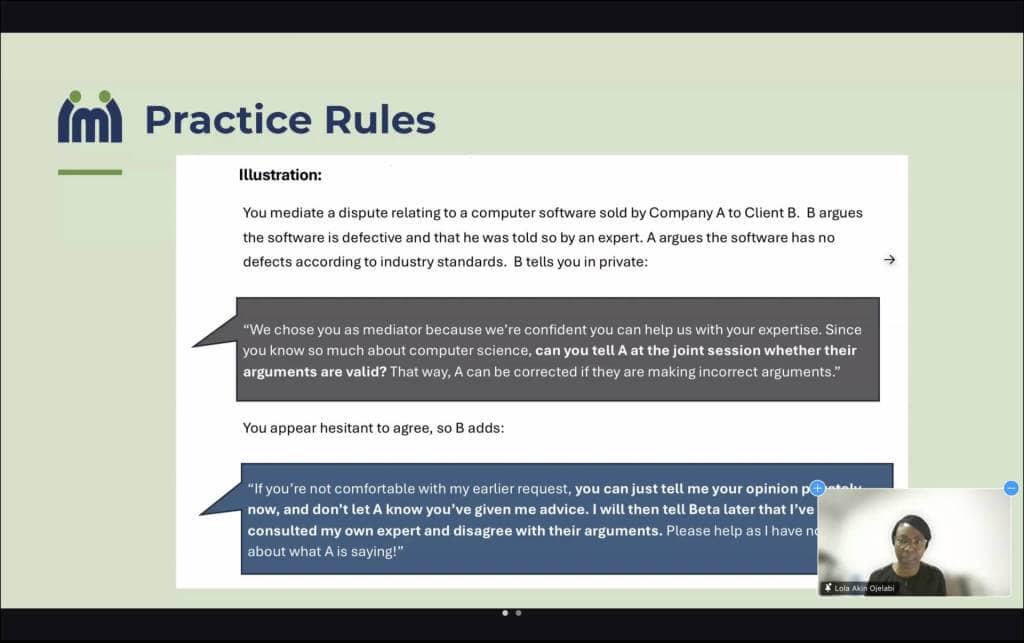
For the second theme of the panel, Lola Akin Ojelabi elaborated on the separation of roles as a component of professional integrity. She discussed a scenario where a mediator had computer science expertise, raising two questions: (1) whether a mediator at the request of the party should provide assessment of arguments made by the other party, and (2) whether the mediator should provide an opinion privately to a party about another party’s arguments.
To answer this, Prof. Ojelabi led the attendees to General Principles 8.3, which provides that a mediator is responsible “to distinguish between their role as a mediator and any other professional role they have”. Additionally, during mediation the mediator “shall not provide the parties with professional services in any capacity other than as a mediator”. In Practice Rules 2.2, it is further expanded that the mediator’s role is to assist the parties to make informed decisions. Additionally, the mediator should not give any advice, but “may recommend that the parties seek external professional advice”.
Responding to a question from Ms. Waldman about parties hiring mediators in the US specifically for subject matter expertise, Prof. Ojelabi confirmed that the consent of both parties is critical. Furthermore, the mediator must consider whether the rules of the practicing venue allow them to act in another capacity, ensuring competence is maintained. The concept of the parties is relevant in relation to what the mediator should or should not do. Ojelabi highlighted that if the mediator provides any other service beyond their role, “that must be by the consent of the parties” and “to be provided in the mediator’s capacity as a mediator”.
Following this practice, Prof. Ojelabi added, ensures that principles of self-determination, voluntariness, impartiality and professional integrity are complied with in the mediation process.
Prevention of Process Abuse
Mary Walker OAM began the third theme of the panel by addressing the mediator’s responsibility for the process. She urged mediators with a legal background to resist the tendency to interrogate when they perceive a potential abuse. Instead, she stressed that mediators must constantly remind themselves that they are there to manage the process, not to provide legal advice or act as an adjudicator.
Ms. Walker presented two integrity scenarios: (1) one concerning process integrity, where a party confidentially withheld information that may constitute fraud, and (2) another regarding outcome integrity, where the mediator suspected a settlement involved tax avoidance. Both cases prompted the core question: “What are the mediator’s ethical obligations?” To illustrate this challenge, Walker referenced two Australian cases that showcased specific and challenging ethical issues that can arise in mediation.
The Draft Code addresses abuse prevention in General Principle 8.5, which requires that a mediator “shall take steps to prevent an abuse of the mediation process or a substantial defect in the process.” These steps include holding discussions with parties (joint or separate), asking parties to consult external experts, postponing the mediation, or, as a last resort, terminating the process. Ms. Walker highlighted that the provisions of the Draft Code offer clear guidance for mediators, allowing them to adjust based on the perceived impact on the parties and the process.
Ms. Walker concluded by asserting that impartiality and integrity are the essential core issues mediators must address when assessing questions of process abuse and fairness.
Creating a Culture of Integrity
Closing up the event, Ellen Waldman addressed how to build a lasting culture of integrity, with a number of mechanisms available to us. The first is to encourage discussion. She explained that mediation can sometimes be a “lonely journey”. Many mediators work alone and processes are confidential, but we can encourage forums where dilemmas can be talked about and foster awareness that these dilemmas exist, discussing specific difficult cases, even those where there is no straight answer.
There are also groups that create formal opportunities for discussion. For example, the IMI-YMI Mentorship framework offers programs for young mediators, or the Monthly Roundtables in New York allows participants to discuss particular topics of their interest. She highlighted that we need more of this as it raises awareness that ethics issues are complex and require thoughtful deliberation. Additionally, there are groups that draft opinions on ethical issues and publish opinions that can then be promulgated, and lend guidance. Prof. Waldman highlighted that there are also disciplinary procedures, where the courts setting up mediation programs have a responsibility to ensure that the rules and the ethics codes are adhered to by the practitioners.
Prof. Waldman concluded that creating a culture of integrity begins with practitioners “talking to one another about these ethics issues” in order “to maintain the public’s trust in the process”.
📖 For a complete review of the material discussed, the slides from the event are available for review.
A Year of Integrity
At the end of the panel, IMI Executive Director Ivana Ninčić Österle affirmed that the discussion resonated with the standard sequence of implementing an integrity culture, which includes drafting a code, but also training, monitoring mechanisms, and implementation. She expressed the aspiration that the public consultation on the Draft Code will help establish links with various local and regional disciplinary committees, commissions, regulatory bodies worldwide.
IMI’s vision extends beyond the week-long focus, aiming for the culture of integrity to permeate mediators’ practice throughout the year. This will enable the mediation community to collectively synchronize efforts and pursue sustained initiatives for learning and exchange.